A distributed vulnerability database for Open Source
An open, precise, and distributed approach to producing and consuming vulnerability information for open source.
Ecosystems
- AlmaLinux
- 6275 View AlmaLinux vulnerabilities
- Alpaquita
- 17076 View Alpaquita vulnerabilities
- Alpine
- 4762 View Alpine vulnerabilities
- Android
- 2912 View Android vulnerabilities
- Azure Linux
- 19625 View Azure Linux vulnerabilities
- BellSoft Hardened Containers
- 862 View BellSoft Hardened Containers vulnerabilities
- Bitnami
- 9924 View Bitnami vulnerabilities
- Chainguard
- 1258628 View Chainguard vulnerabilities
- CleanStart
- 8084 View CleanStart vulnerabilities
- crates.io
- 2871 View crates.io vulnerabilities
- Debian
- 71830 View Debian vulnerabilities
- Echo
- 4856 View Echo vulnerabilities
- GIT
- 113387 View GIT vulnerabilities
- GitHub Actions
- 55 View GitHub Actions vulnerabilities
- Go
- 9600 View Go vulnerabilities
- Hackage
- 33 View Hackage vulnerabilities
- Hex
- 412 View Hex vulnerabilities
- Julia
- 1713 View Julia vulnerabilities
- Linux
- 30072 View Linux vulnerabilities
- Mageia
- 6325 View Mageia vulnerabilities
- Maven
- 7086 View Maven vulnerabilities
- MinimOS
- 182710 View MinimOS vulnerabilities
- npm
- 230075 View npm vulnerabilities
- NuGet
- 1924 View NuGet vulnerabilities
- opam
- 35 View opam vulnerabilities
- openEuler
- 9200 View openEuler vulnerabilities
- openSUSE
- 14968 View openSUSE vulnerabilities
- OSS-Fuzz
- 4044 View OSS-Fuzz vulnerabilities
- Packagist
- 7191 View Packagist vulnerabilities
- PyPI
- 25999 View PyPI vulnerabilities
- Red Hat
- 23995 View Red Hat vulnerabilities
- Red Hat Lightwell
- 219 View Red Hat Lightwell vulnerabilities
- Rocky Linux
- 4563 View Rocky Linux vulnerabilities
- Root
- 19778 View Root vulnerabilities
- RubyGems
- 5397 View RubyGems vulnerabilities
- SUSE
- 23936 View SUSE vulnerabilities
- SwiftURL
- 61 View SwiftURL vulnerabilities
- TuxCare
- 9676 View TuxCare vulnerabilities
- Ubuntu
- 68698 View Ubuntu vulnerabilities
- Wolfi
- 375894 View Wolfi vulnerabilities
- WordPress
- 30311 View WordPress vulnerabilities
OSV schema
All advisories in this database use the OpenSSF OSV format, which was developed in collaboration with open source communities.
The OSV schema provides a human and machine readable data format to describe vulnerabilities in a way that precisely maps to open source package versions or commit hashes.
{
  "schema_version": "1.7.4",
  "id": "GHSA-c3g4-w6cv-6v7h",
  "modified": "2022-04-01T13:56:42Z",
  "published": "2022-04-01T13:56:42Z",
  "aliases": [ "CVE-2022-27651" ],
  "summary": "Non-empty default inheritable capabilities for linux container in Buildah",
  "details": "A bug was found in Buildah where containers were created ...",
  "affected": [
    {
      "package": {
        "ecosystem": "Go",
        "name": "github.com/containers/buildah"
      },
      "ranges": [
        {
          "type": "SEMVER",
          "events": [
            {
              "introduced": "0"
            },
            {
              "fixed": "1.25.0"
            }
          ]
        }
      ]
    }
  ],
  "references": [
    {
      "type": "WEB",
      "url": "https://github.com/containers/buildah/commit/..."
    },
    {
      "type": "PACKAGE",
      "url": "https://github.com/containers/buildah"
    }
  ]
}Data sources
This infrastructure serves as an aggregator of vulnerability databases that have adopted the OSV schema, including GitHub Security Advisories, PyPA, RustSec, and Global Security Database, and more.
Use the API
An easy-to-use API is available to query for all known vulnerabilities by either a commit hash, or a package version.
Query by commit hash
curl -d \
  '{"commit": "6879efc2c1596d11a6a6ad296f80063b558d5e0f"}' \
  "https://api.osv.dev/v1/query"
Query by version number
curl -d \
  '{"version": "2.4.1",
    "package": {"name": "jinja2", "ecosystem": "PyPI"}}' \
  "https://api.osv.dev/v1/query"
Vulnerability Scanner
Install OSV‑Scanner
go install github.com/google/osv-scanner/v2/cmd/osv-scanner@v2
Scan SBOM or Lockfiles
osv-scanner --sbom=cycloned-or-spdx-sbom.json
osv-scanner --lockfile=package-lock.json
Scan directory recursively
osv-scanner -r path/to/your/project
Remediation Tools
Guided Remediation (basic)
osv-scanner fix --non-interactive --strategy=in-place -L path/to/package-lock.json
osv-scanner fix --non-interactive --strategy=relock -M path/to/package.json -L path/to/package-lock.json
Guided Remediation (interactive)
osv-scanner fix -M path/to/package.json -L path/to/package-lock.json
Container Image Scanning
You can use OSV-Scanner to scan your container images for known vulnerabilities.
Scan container image
osv-scanner scan image --serve alpine:3.12

GitHub Workflows
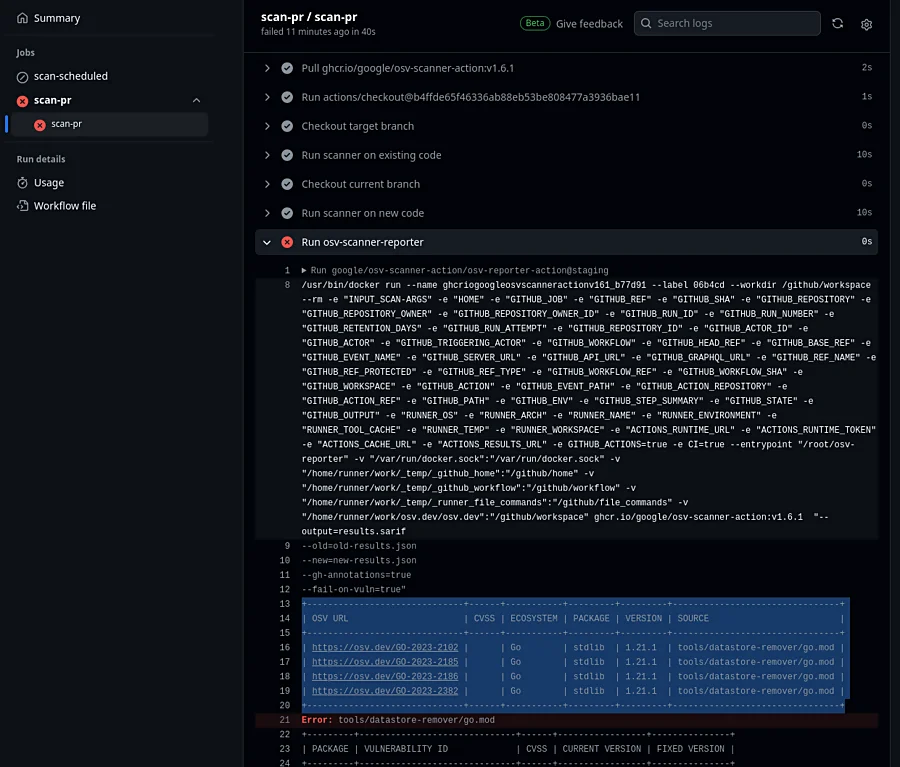
OSV-Scanner also provides reusable GitHub workflows that can be easily integrated into CI/CD pipelines to provide continuous vulnerability scanning coverage. This can scan newly added dependencies in pull requests for introduced vulnerabilities, as well as perform regular vulnerability scans for the entire project.